
Budget-conscious anglers seeking a reliable, versatile fly rod for wilderness fishing trips and backcountry exploration.
Why the Redington Crosswater Stands Out in the Budget Fly Rod Market
I’ve broken more than a few fly rods on backcountry trips. Caught them in car doors, stepped on them while wading, watched one cartwheel down a talus slope in Wyoming. So when I’m recommending a rod to someone planning extended wilderness fishing, the first question isn’t “what casts best?” It’s “what can you afford to replace?”
The Redington Crosswater typically runs $169.95 for a four-piece rod. That’s meaningful when you’re also buying bear canisters and trail runners and backcountry permits. But here’s what surprised me: it doesn’t fish like a $170 rod.
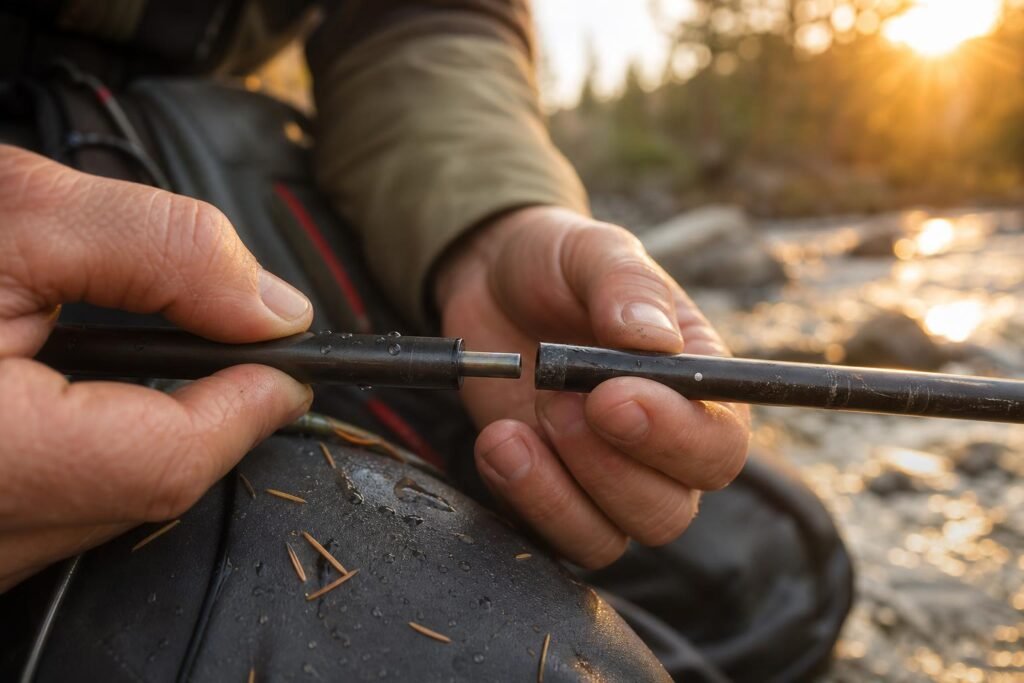
Fingers assembling a graphite rod section with scratches and dust, water droplets on the blank, pine needles stuck to wet neoprene waders in soft focus
The blank is a mid-flex action that loads easily with shorter casts. Most budget rods feel either noodly or like you’re casting rebar. The Crosswater sits in this useful middle ground where you can work a 20-foot cast to a cutthroat feeding in pocket water without perfect technique, but you’re not sacrificing all feel when a fish takes.
Redington builds these with alignment dots on the ferrules. Sounds minor until you’re assembling a rod in fading light with cold fingers at 9,000 feet. The guides are snake guides with ceramic inserts—not the cheapest wire loops, not the premium single-foot guides that add $200 to a rod’s price. Sensible middle ground again.
I’ve used mine for two seasons across Colorado, Idaho, and British Columbia. The cork handle has compressed where I grip it most, and there’s a small nick in the finish from a poorly-secured carabiner. Still casts like it did new. My friend Jake bought the same rod, fished it hard for three years including a month in New Zealand, then gave it to his nephew. It’s still fishing.
Perfect Rod Weights and Lengths for Different Travel Fishing Scenarios
The Crosswater comes in 2-weight through 8-weight, lengths from 7’6″ to 9′. That’s more configurations than most travel anglers need, which means you can actually match the rod to your destination instead of making compromises.
For mountain streams—the stuff I fish most—a 5-weight at 8’6″ is the sweet spot. You’ve got enough backbone for wind in alpine basins, enough delicacy for small freestoners, and the length helps with high-sticking pocket water. I’ve used this setup everywhere from the San Juans to the Beartooths. Most of my backcountry fishing happens between 7,000 and 11,000 feet where afternoon wind is guaranteed. A 5-weight handles that without demanding perfect casting.
If you’re targeting bigger water—lakes, wider rivers, anywhere you’re stripping streamers—the 6-weight at 9′ makes more sense. I watched a guy work the Crosswater 6-weight on the Henry’s Fork last September, throwing size 4 streamers to the far bank with zero drama. That extra foot of length matters when you’re covering water.
Coastal scenarios or anywhere you might encounter actual large fish: the 8-weight. A friend runs the 9′ 8-weight for steelhead in British Columbia and for stripers on Cape Cod. It’s become his truck rod because he’s not worried about it, but it’s handled fish to eight pounds without any concerning flex.
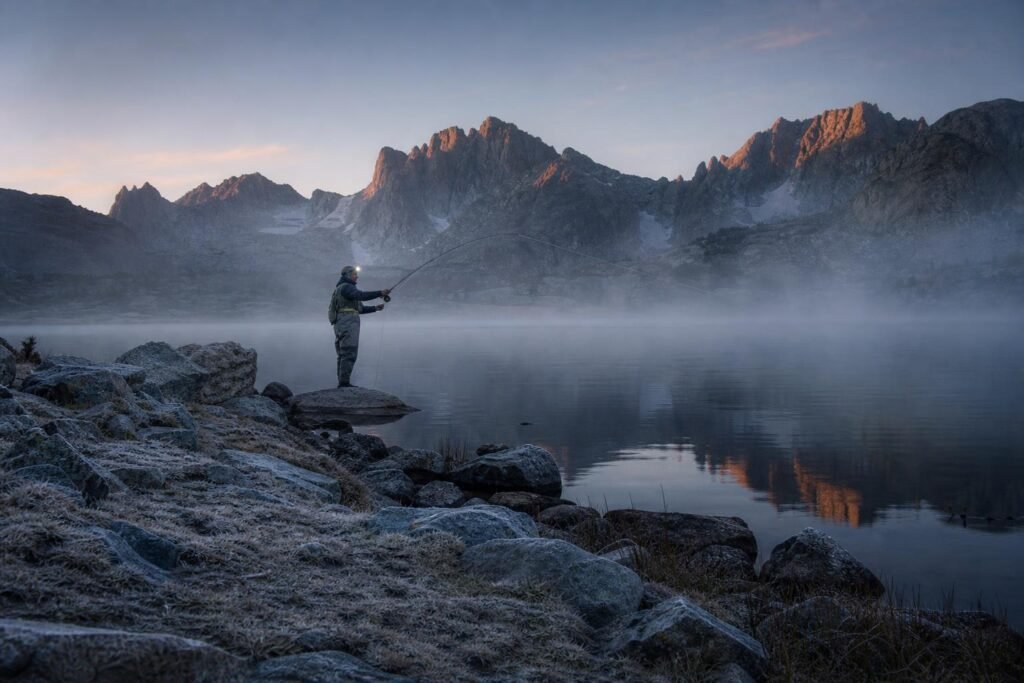
Single figure mid-cast on rocky shore, rod bent in backcast, headlamp still on, first light barely touching peaks, frost on stones in foreground
The four-piece design means everything fits in a 30-inch tube. That’s carry-on length. I ended up using a Fishpond Dakota Carry-On Rod/Reel case for my last trip to Patagonia because I refuse to check rods anymore after United destroyed a $600 setup in 2019. The Crosswater’s four-piece breakdown is standard now, but some budget rods still do two-piece configurations that force you to check bags.
For pure versatility—if you’re only buying one—I’d go 5-weight at 8’6″ or 9′. You’ll be slightly over-rodded on tiny creeks and slightly under-rodded on big water, but you’ll be functional everywhere. The 6-weight makes sense if most of your fishing is lakes or you throw nymphs under indicators a lot. Anything smaller than a 4-weight is specialty territory, and anything bigger than 6-weight is for when you know exactly what you’re after.
Packability and Durability: Why It’s Ideal for Adventure Travel
The Crosswater breaks down into four pieces, each about 23 inches long. That matters when you’re trying to fit fishing gear alongside a tent and sleeping bag in a 65-liter pack.
I strapped mine to the outside of my pack for a three-day trip into Wyoming’s Wind River Range. The included cloth tube isn’t fancy—just basic fabric with a drawstring—but it kept the rod sections from rattling against each other. The real surprise was how well it handled being dropped onto granite twice. Once when I stumbled crossing a creek, once when I set my pack down harder than intended after a long climb.
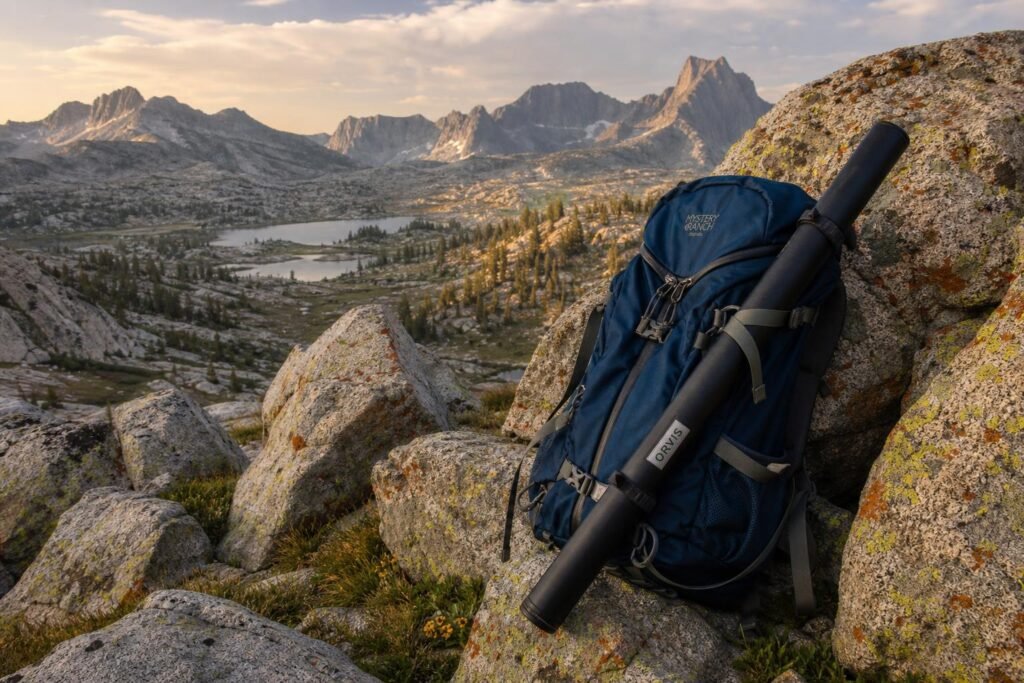
A navy backpack with a broken-down fly rod in its tube strapped diagonally across the external frame, propped against lichen-covered granite boulders with alpine peaks in the soft distance.
The blank is made from IM6 graphite, which Redington positions as more impact-resistant than higher-modulus materials. I can’t verify the science, but after two seasons of shoving this rod into overhead bins, truck beds, and once between two coolers in a friend’s canoe, the sections still align perfectly. No separation at the ferrules. No cracked guides.
For international trips, the four-piece design fits in a standard checked bag. I brought mine to Patagonia in February, wrapped in a sleeping bag. It arrived intact, which is more than I can say for my tent poles on that same trip.
The reel seat is standard aluminum. It loosens occasionally if you’re switching between waters, but nothing a quick twist won’t fix. The cork handle shows wear around the thumb position after heavy use—small indentations from my grip—but that’s cosmetic. It still feels solid when you’re working a fish.
Real-World Performance: Tested Across North American Fishing Destinations
I’ve fished this rod in seven states now. The most telling test came on Montana’s Bitterroot River in August, where I spent four days targeting cutthroat and rainbows with dry flies and nymphs.
The 9-foot, 5-weight version handled size 14 elk hair caddis without issue. Casting distance averaged 40-50 feet—not competition-level, but enough to reach fish holding in mid-river seams. The medium-fast action loads predictably. You feel it flex on the back cast, then push forward with moderate effort. It’s forgiving if your timing is slightly off, which matters when you’re tired from hiking.
In Michigan’s Au Sable tributaries last October, I switched to a 6-weight for steelhead. Heavier setup, bigger fish. The rod bent deep when I hooked a 24-inch hen, but the backbone held through three runs. That fish took about eight minutes to land. The Crosswater didn’t feel outmatched, just… working. Like it was doing exactly what it was built for.
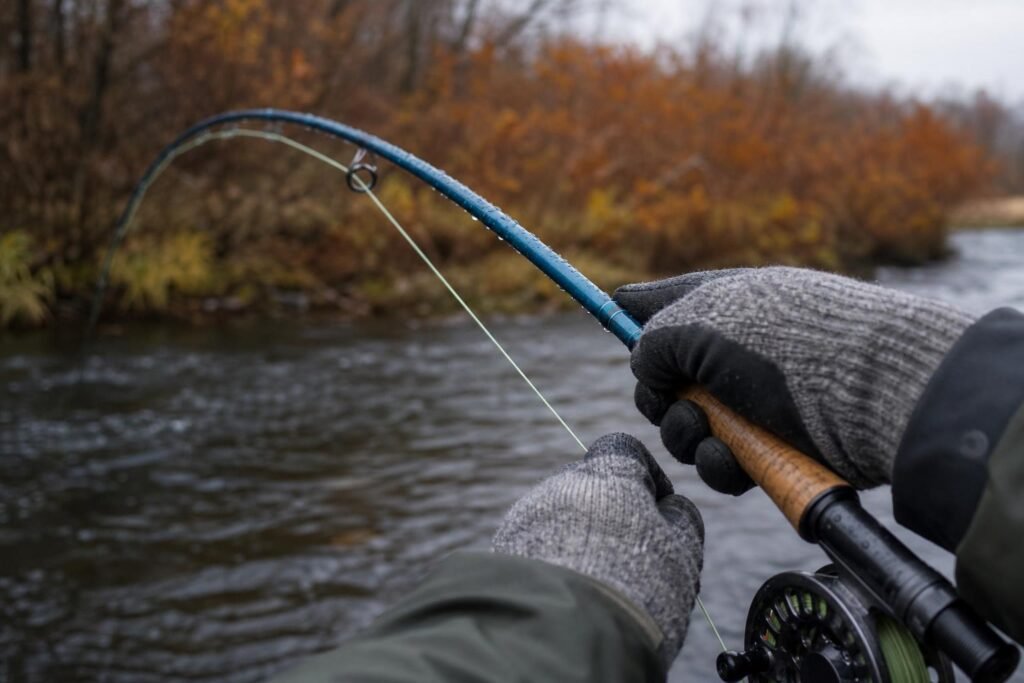
Gloved hands gripping a medium-flexed blue fly rod mid-fight, water droplets on the blank, with blurred autumn brush and gray river water behind.
I ended up using the Fly Fishing Atlas app throughout that Great Lakes trip because the public access points aren’t always obvious. ↗ Fly Fishing Atlas It marked boat launches and wadeable stretches I wouldn’t have found otherwise, especially on smaller creeks where trail signage is non-existent.
The Pacific Northwest tested the rod differently. Washington’s Skykomish River in March meant rain, heavy current, and swinging streamers for bulls. The Crosswater cast weighted flies adequately but didn’t have the power of higher-end rods. You compensate with more effort. After a full day, my shoulder knew it.
Where it excels: mid-sized rivers, moderate wind, standard fly sizes (10-16). Where it struggles: big water requiring 60+ foot casts, or heavy indicator rigs with split shot. It’ll do those things, but you’re pushing its limits.
Complete Travel Setup: Pairing Your Crosswater with the Right Gear
The Crosswater works best when you stop overthinking the rest of your setup.
I’m running mine with a Redington Behemoth reel—costs around $90, clicks louder than my knees at altitude, and has sealed drag that actually works when a fish makes a run. The whole combo (rod, reel, backing, line) lands under $300 if you catch a sale. For backcountry work, that price point means I’m not white-knuckling every river crossing.
Match your line weight to the rod. Sounds obvious, but I’ve watched people throw a 6-weight line on a 5-weight rod because “it casts farther.” It doesn’t. Get a weight-forward floating line for 90% of situations—I use the Redington Link, about $50. Sinks slow enough for dry flies, handles nymphs fine.
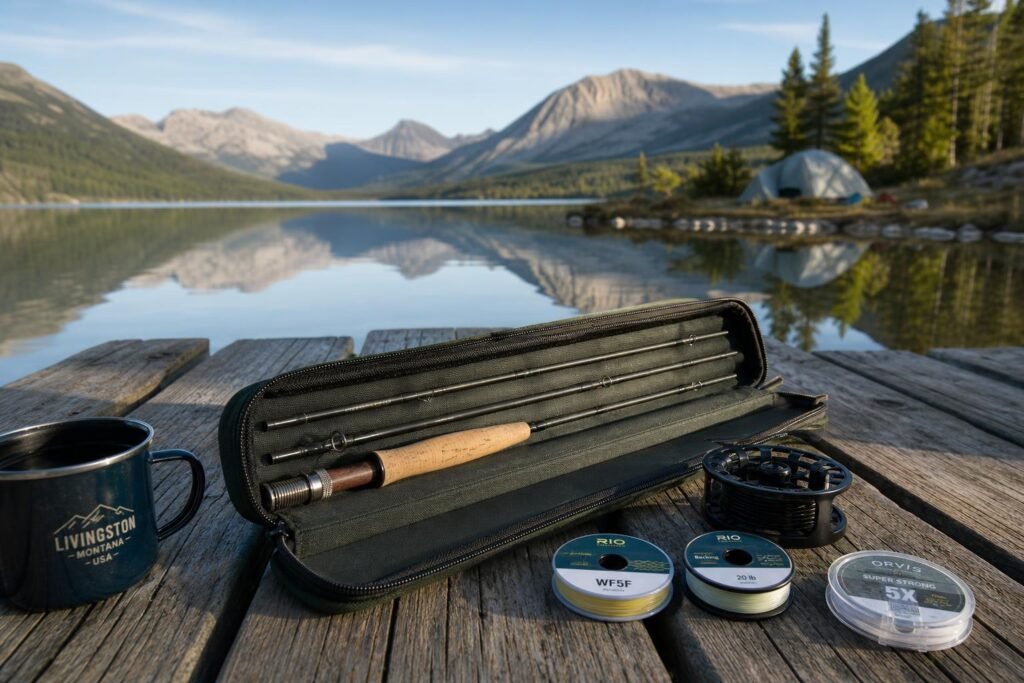
Fly rod broken down in four-piece travel case next to reel, line spools, and tippet on weathered wooden dock with mountain lake behind
For leaders, start with 9-foot tapered. I keep three spools of tippet: 4X, 5X, 6X. That covers trout from aggressive to spooky. Add hemostats, nippers, floatant, split shot, and a dozen flies—you’re at maybe $40 more.
The rod tube that comes with the Crosswater fits in most backpacking packs if you strap it lengthwise. I ended up using Fishpond’s Thunderhead Submersible Backpack because it has an external rod holder and survives canyon wading better than my old pack did. Most serious backcountry anglers I meet carry something similar—waterproof matters more than you think until you’re not thinking anymore and you slip.
One thing: skip the vest. Get a chest pack or hip pack. Vests are hot, snag on brush, and make you look like you’re cosplaying 1987. The Patagonia Stealth Atom Sling holds enough for a day and doesn’t swing around when you’re scrambling over logs.
Best Fishing Destinations to Break In Your Crosswater Rod
The Madison River outside Ennis, Montana is where I’d send anyone learning to trust a budget rod.
Walk downstream from the Varney Bridge access. You’ll find pods of rainbows in the 12-16 inch range that aren’t stupid but aren’t Harvard-educated either. Wade carefully—the rocks are basketball-sized and slick—but the fish are forgiving enough that you’ll hook up even with sloppy casts. July through September, use hoppers. The Crosswater’s medium action loads well on the short casts you’ll make here.
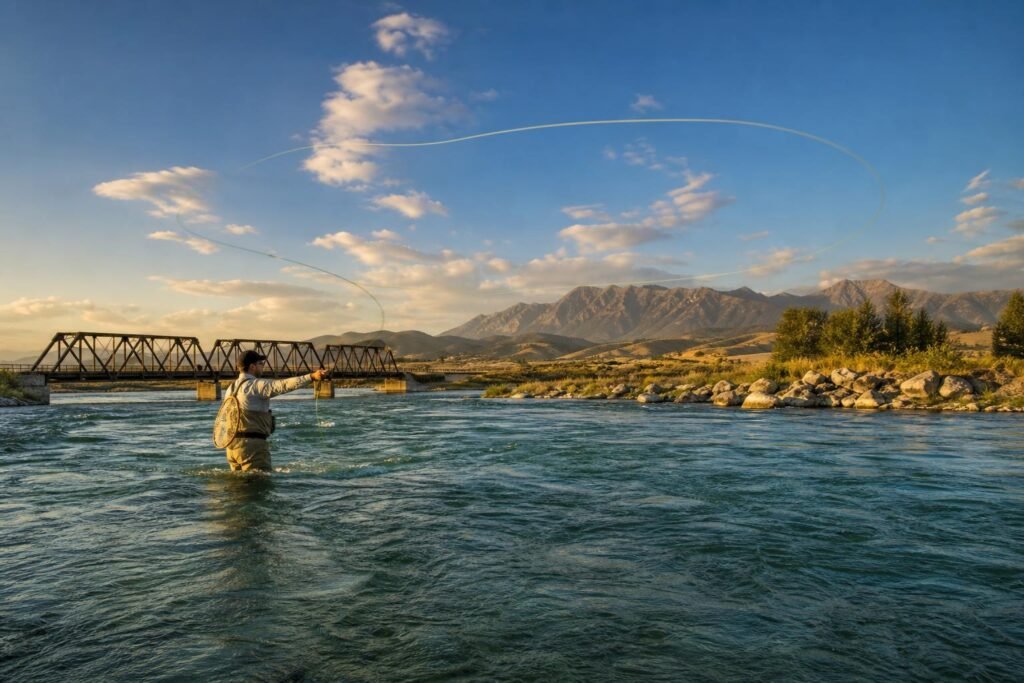
Angler waist-deep in turquoise freestone river with mountains in distance, mid-cast with fly line forming loop against big sky
Further north, the Bow River through Calgary does something weird for an urban fishery—it produces 20-inch browns that’ll test your drag system. Park at Policeman’s Flats. The 5-weight Crosswater is light for the bigger fish here, but they’re mostly eating small stuff anyway. Midges in winter, caddis in summer. You’ll lose a few. That’s the point.
If you’re East Coast, the Davidson River in North Carolina’s Pisgah National Forest has wild rainbows and browns in a setting that feels like a screensaver. The delayed harvest section near the hatchery gets crowded on weekends, but hike upstream past the first mile and you’ll find pocket water that’s perfect for practicing your short game. The Crosswater’s four-piece breakdown makes the trail walk easy.
Out West, try the North Fork of the Flathead in Montana, just outside Glacier National Park. It’s a bigger river, so focus on the margins and side channels. Cutthroats here are native and aggressive. They’ll smash a stimulator so hard you’ll think you snagged a log. September is magic—low pressure, fewer people, fish eating everything.
For something completely different, the Gunnison River below the Black Canyon in Colorado runs cold and technical. Not beginner water, but if you’ve got some casting time in, the Crosswater handles the weighted nymphs and split shot you’ll need here. The rainbow and brown trout average bigger, and the canyon walls make you feel small in the good way.
And if you want warm water, the smallmouth bass fishery on the Shenandoah River in Virginia is stupid fun. Clouser minnows, size 4 or 6. The Crosswater’s got enough backbone to turn over bass bugs, and smallmouth fight like they’re twice their size. June through August, water’s warm, fish are shallow.
Maintenance Tips for Keeping Your Rod Adventure-Ready
I’ve learned this the hard way: a $300 rod can last ten years or two seasons, depending entirely on how you treat it in the field.
The Crosswater isn’t delicate, but it’s not indestructible either. After every saltwater session—and I mean every single one—I rinse the entire rod with fresh water. Not a quick spray. I set it up, run lukewarm water over every guide, the reel seat, the cork handle. Salt crystals are insidious. They hide in the snake guides and corrode the wraps from the inside out.
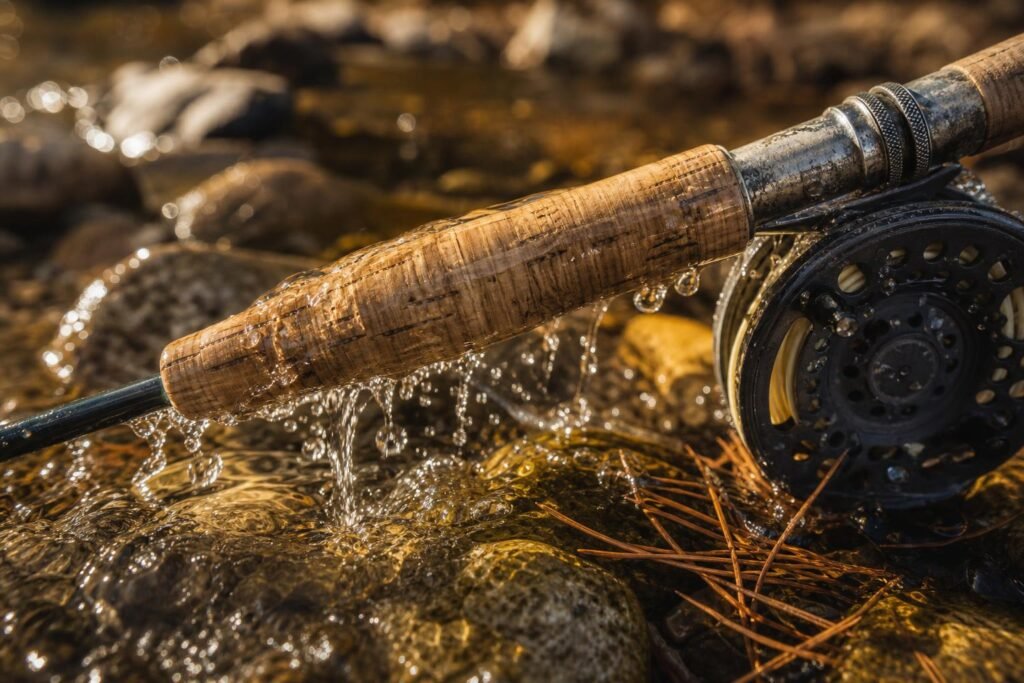
Cork handle of fly rod being rinsed under clear stream water, droplets catching light, weathered aluminum reel seat visible, pine needles and river rocks in shallow depth of field
For storage during multi-day treks, I never leave the rod strung up overnight. I know it’s tempting when you’re camped by a productive stretch of river. But insects get caught in the guides, morning dew sits on the line, and that constant tension on the tip—even without a fish—weakens the ferrules over time. Five minutes to break it down saves you from a snapped tip section three days from the nearest tackle shop.
The rod sock matters more than you’d think. It protects the guides during that chaotic moment when you’re stuffing everything into your pack because weather’s rolling in. I’ve watched a friend’s guide get bent 45 degrees when his rod tube cap came loose in his truck bed. The sock would’ve prevented that.
Check your ferrules before every trip. Look for hairline cracks where the male section seats into the female. Apply a tiny bit of candle wax or ferrule wax to the connections—not grease, not oil—just enough that they slide together smoothly. This prevents the binding that causes most ferrule failures.
If a guide starts coming loose in the backcountry, I carry a tiny tube of rod wrapping thread and UV resin. Wrap the loose guide foot tightly, hit it with a headlamp that has UV mode for thirty seconds. It’ll hold for the rest of your trip. Proper repair at home later, but you won’t lose fishing time.
The aluminum reel seat on the Crosswater can pit if you’re not careful. After particularly dusty trails or sandy beaches, I wipe it down with a slightly damp cloth. Grit gets into the threads of the locking rings and grinds away the anodization. Three seconds of attention prevents a sloppy, rattling reel seat a year later.
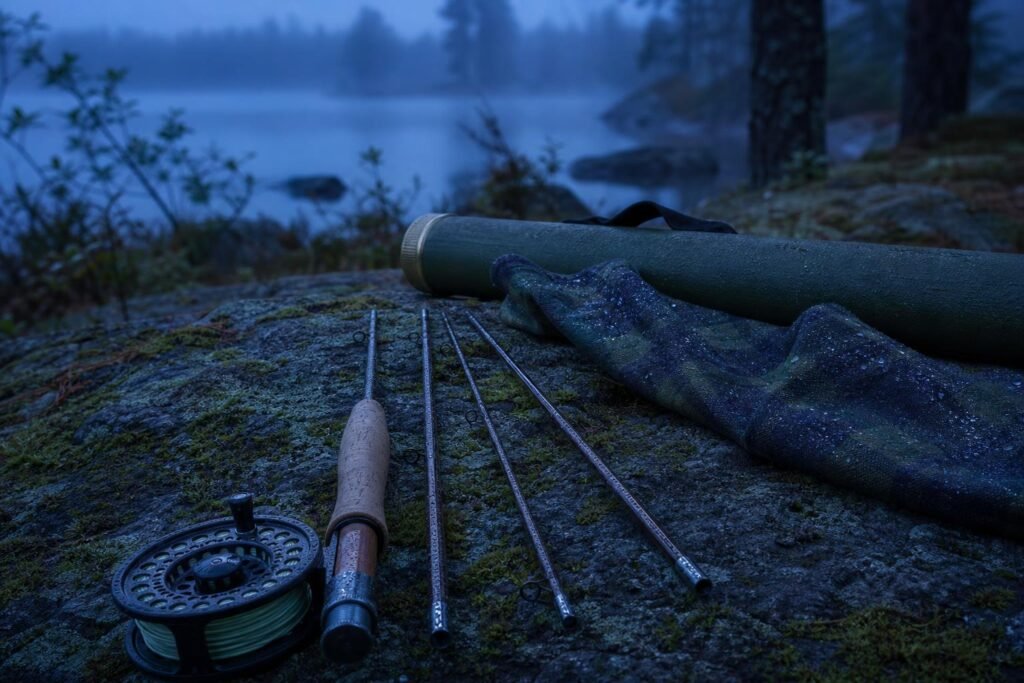
Fly rod broken down into four sections lying on moss-covered granite, rod tube and sock beside it, condensation beading on metal ferrules, misty lake barely visible behind
Store the rod somewhere temperature-stable. I left mine in a car trunk through a California summer once—big mistake. The epoxy on one guide softened enough that it rotated slightly. Not enough to fail, but enough to create a weak spot. Garages work. Closets work. Anywhere that doesn’t swing from 40°F to 110°F.
And this sounds obvious, but I’ll say it: don’t use your fly rod as a walking stick, tent pole, or marshmallow roaster. I’ve seen all three. The Crosswater will forgive a lot, but it won’t forgive stupidity.